Natural Dayighting System

Welcome to the home page.

HOME > SERVICES > Natural Dayighting System

Natural Dayighting System

System Overview

What is a natural daylighting system?

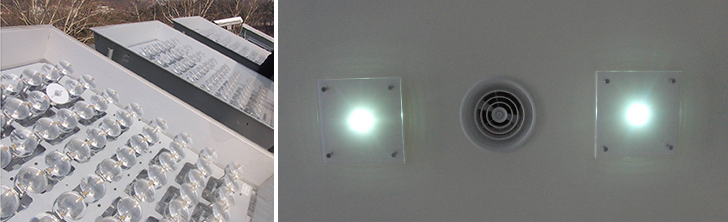
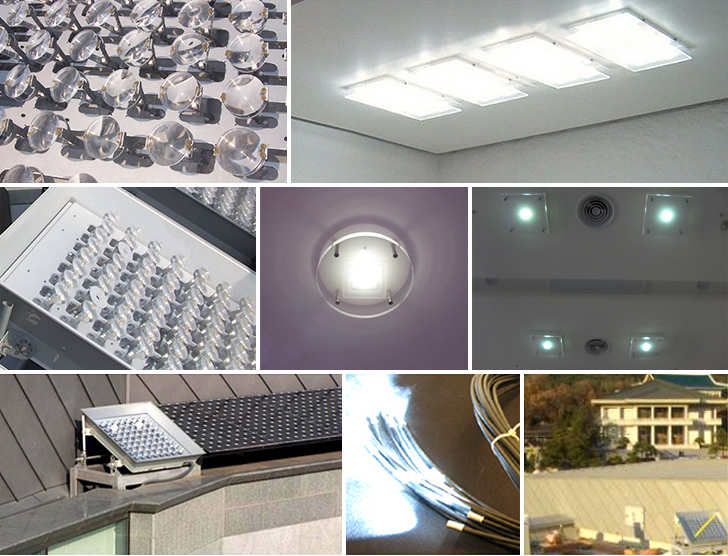
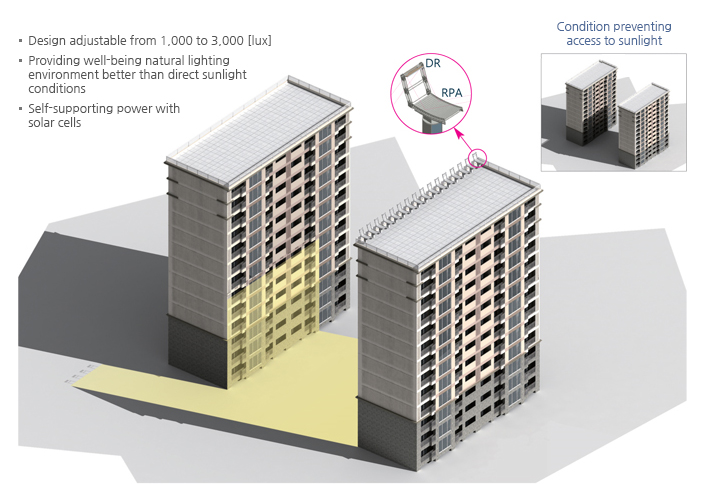
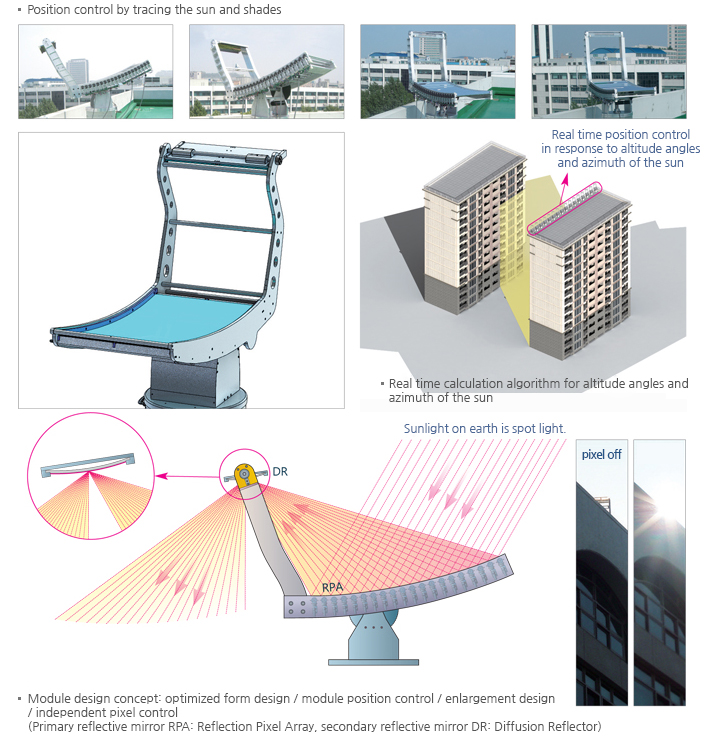
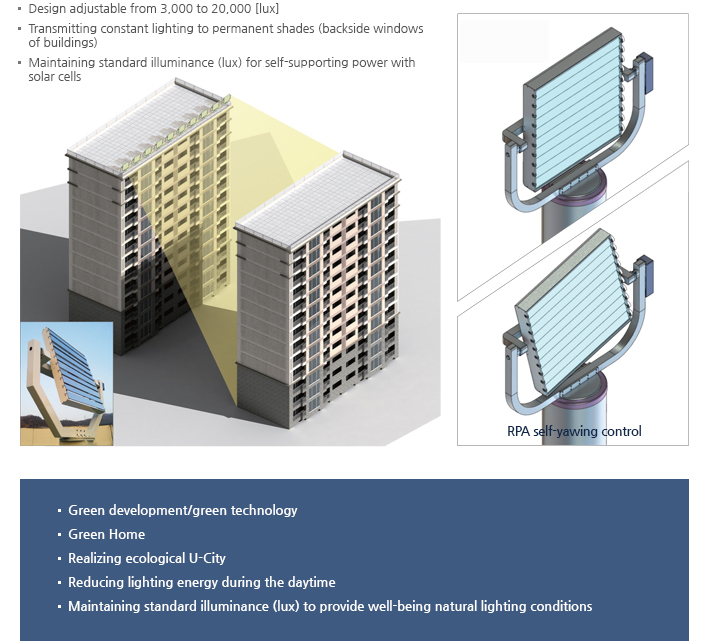
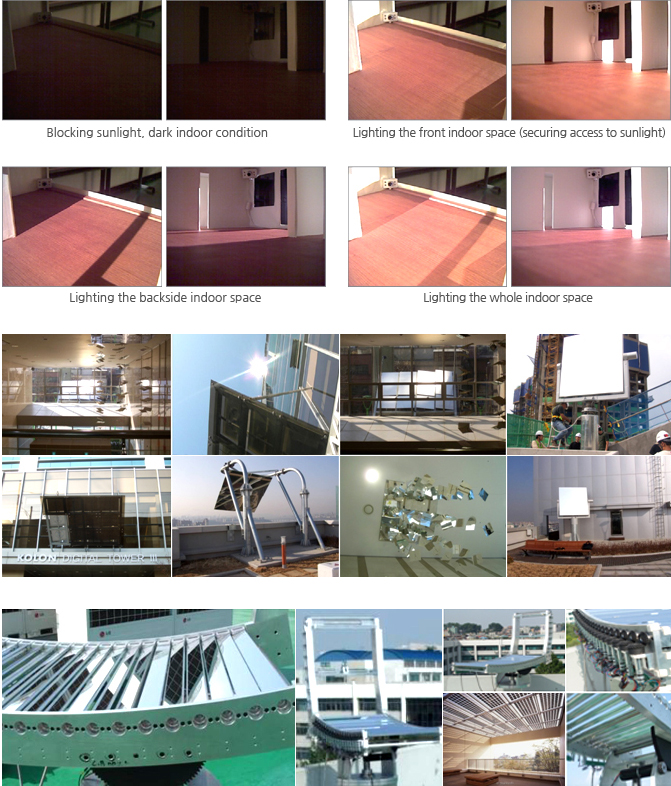
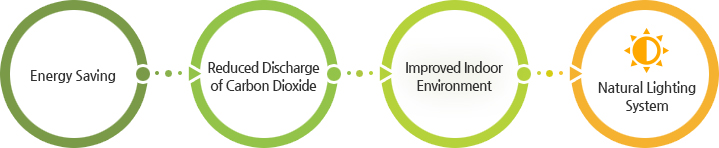
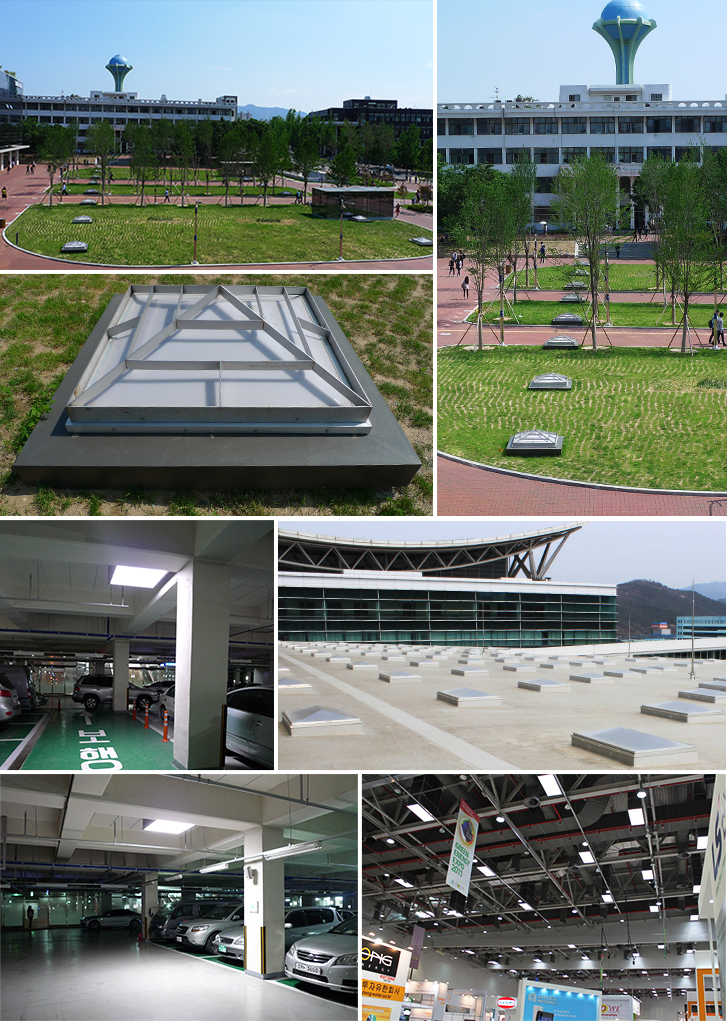
A natural daylighting system introduces natural light into indoor spaces to which such light hardly gets in by means of optic hardware. It can save lighting energy and facilitate various hygienic effects such as sterilization, dehumidification and natural lighting for growing plants offered by sunlight.
natural daylighting system

Effects of the Natural Daylighting System

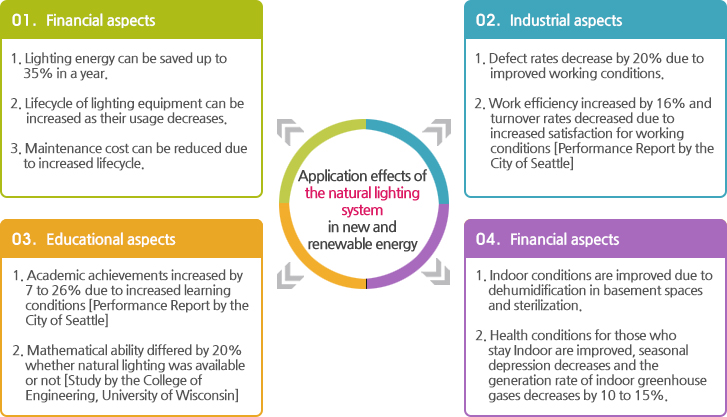
Application effects of the natural daylighting system in new and renewable energy

Application effects of the natural daylighting system in new and renewable energy

Generating Energy

  • Natural daylighting systems are included in the mandatory items of new and renewable energy for public organizations (light collecting and lighting area)
New and Renewable Energy Source Unit Energy Production Correction Factor Per Source
Light Collecting
(Natural Daylighting)
Prism 94.7 kWh / set · yr 11.70
Daylight Duct 139.7 11.70

Article 48 of Guideline on Supporting for New and Renewable Energy Facilities, 2014-9 by Korea Energy Agency

  • Prism energy production marks 1,107 kWh/set · yr (calculation basis: 94.7 x 11.7).
  • Daylight duct energy production marks 1,634 kWh/set · yr (calculation basis: 139.7 x 11.7).

Improving Working Conditions

  • Defect rates decrease by 20% due to improved working conditions.
  • Work efficiency increases by 16% and turnover rates decrease due to increased satisfaction for working conditions.

Improving Learning Conditions

  • Academic achievements increase by 26% due to improved visual conditions.
  • It was reported that Mathematical ability differed by 20% whether natural lighting was available or not.

Improving Health Conditions

  • Indoor conditions are improved by dehumidification, sterilization and greening.
  • Synthesis of vitamin D for those who stay indoor is facilitated, seasonal depression decreases and the generation rate of indoor greenhouse gases decreases by 15%.

Technical Data for Natural Daylighting Systems

Reasons to apply and effect of natural daylighting systems (reducing cooling loads and energy)

Examples of reduced energy by natural daylighting systems (in Korea)

1) Usage of lighting energy
= lighting power in a store (40W/) x floor area (1,000) = 40kW
2) Heating value of lighting equipment (for use of 30W fluorescent lamp)
= heating value of 30W fluorescent lamp (1,030kcal/h · kW) x lighting usage (40kW) = 41,200kcal/h (based on daytime use (09:00 to 17:00) when electrical lighting usage decreases by 50% due to application of natural daylighting systems)
  • Reduced electrical energy of 58,400kW in a year - unit charge 72 won X 58,400kW = 4,204,800 won
  • Reduced cooling energy of 60,152,000kcal in a year - unit charge 72 won X = 28,744kW = 5,035,982 won

Examples of reduced energy by natural daylighting systems (in other countries)

aylight-the Coolest
Lighting Source for Buildings

Air
- Conditioning Load for 100,000 lumens of light (light equivalent to 30~40 fluorescent lamps)
- From incandescent lights : 1.90 tons
- From fluorescent lights : 0.63 tons
- From shaded daylight : 0.27 tons

Daylighting Collaborative-Light Every Building with Only the Sky

Replacing lighting energy

Calculation of alternative power for electrical lighting per area in a year

Standard Illuminance
(lx)
Lighting Power Consumption Per Area (w/)
Number of Days
Valid Lighting Duration in a Day (h)
Alternative Lighting Power Per Area in a Year (kw · yr/)
450
40
365
8
58.4

1. Alternative lighting area 1,000 58.4kw · yr / = annual energy consumption 58,400kw · yr
2. Reduced electrical charges 58,400kw · yr 72 won/kw = 4,204,800 won / yr
3. Reduced charges by lifecycle of lighting equipment : 0.5 lamp per 1 lighting area 1000 0.5 = 500 lamps
4. Increased lifecycle of lighting equipment : 8h/day 365/yr 500 10,000 = 146lamps 2,600won = 379,600won/yr
5. Basic electrical charges 5,170 won 12 months = 62,040 won
6. Cost to replace equipment: approx. 300,000 won

= 4,946,440 won/yr

Growing Plants

Effect of the natural daylighting systems on growing plant

1) Effect of the natural daylighting systems (sun pipes) on photosynthesis and chlorophyll

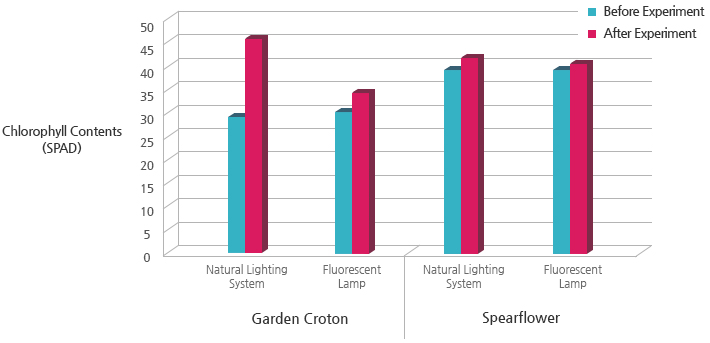
Chlorophyll Contents of Garden Croton and Spearflower
Chlorophyll Contents of Garden Croton and Spearflower

Chlorophyll Contents of Garden Croton and Spearflower for Standard Quantity of Light

Chlorophyll Contents of Garden Croton and Spearflower
For Garden Croton
Lighting condtions by natural light indicated bigger chlorophyll contents and photosynthesis amount than fluorescent lamp by 32.9% and 48.5% respectively. For spearflowers, natural daylighting systems increased chlorophyll contents and photosynthesis amount by 3.5% and 9.6% respectively as an average.
Growing conditions by lighting sources may differ depending on types of plants but natural lights are better than fluorescent lamp in growing plants.
2)Effect of optic fibred lighting systems on growing plants (Choi Gyeong-ok & Bang Gwang-ja, 2002)
Number of leaves is an important factor that increases the appreciation value of plants and, for Ardisia pusilla, the average number of leaves was 9.96 when using optic fibred lighting systems while the number was 7.48 when using fluorescent lamps at 500lux. The average number of leaves was 10.92 when using optic fibred lighting systems while the number was 8.90 when using fluorescent lamps at 1000lux suggesting that optic fibers were better in growing plants. For Anthurium scherzerianum, the efficiency of using CO2 at 1000lux was 0.96 when using optic fibers while the efficiency was 0.93 when using fluorescent lamps.
Optic fibers showed better performance than fluorescent lamps for appreciation values or living conditions of plants and therefore they can be used as main lighting sources to facilitate plant growth in future.

Effect of natural daylighting systems on growing plants

1) Financial and industrial aspect
- natural daylighting systems can reduce air conditioning costs by controlling the temperature conditions (Lee Na-yeong, 2008).

Photosynthesis Amount of Garden Croton and Spearflower for Standard Quantity of Light
Chlorophyll Contents of Garden Croton and Spearflower
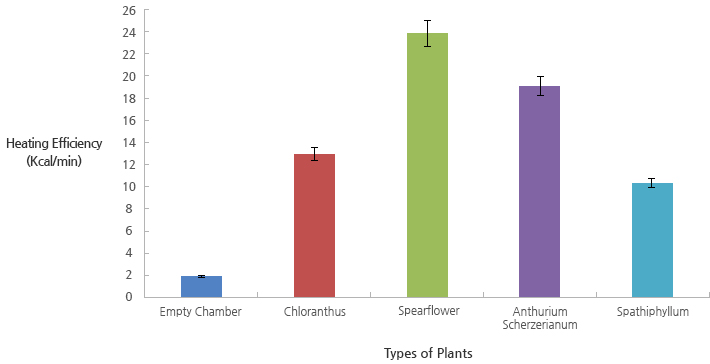
When the temperature decreases from 28 to 26, the cooling calories in spaces to grow spearflowers indicated 23.80kcal · min which was 13.6 times bigger than 1.75kcal · min in non-growing conditions. For Anthurium scherzerianum and Chloranthus, they showed cooling effects 9.9 times and 6.5 times bigger than non-growing conditions respectively.

Heating Efficiency of Different Plants When the Temperature Decreases from 26 to 24

ũ ڱݿ ϼ Է
When the temperature decreased from 26 to 24, spearflowers increased the cooling effect better than non-growing conditions by 47.08% while Spathiphyllum and Chloranthus increased the cooling effect by 43.80% and 32.28% respectively indicating that such plants were effective in controlling indoor temperature.
  • Modularization of plant panels and auto control system can reduce maintenance cost and allows efficient control.
  • Underground spaces, which are not good for growing plants, can be used as functional and complicated ones by establishing wall-type greening spaces using natural daylighting system simulations.
2) Environmental aspect
  • It can improve the air quality in underground spaces by removing fine dust and various volatile materials.
  • It can control temperature and humidity to a comfortable level by transpiration (Lee Gyu-in et al., 2007)
Places with plants indicated lower temperatures by 5 to 8 during the hot daytime and higher temperatures by 2 during the cold nighttime while relative humidity in places without plants indicated 40% during the daytime and 70% during the nighttime resulting in greater differences but relative humidity in places with plants was maintained at constant levels showing that temperature and humidity is controlled by plants.
3) Technical aspect
  • It no longer functions as wall-type greening for landscape only but leads to a new type of greening technology by means of new and renewable energy (natural light).
  • Underground spaces can also be used as green ones and green places are expanded by introducing natural lighting simulations.
4) Emotional aspect
  • It can preserve a variety of resources by developing excellent air switching plants that can be very useful not only in Korea but in the world.
  • It can induce psychological and emotional stability by establishing green spaces indoor.
  • A variety of plants leads to new designs creating visual beauty.
References
Lee Gyu-in, Lee Jae-hak & Gwon Min-jae, 2007
Study on Improvement of Indoor Air Quality by Matching Plants on Balcony, Journal for Construction Association of Korea 23(8): p. 263-271, Lee Na-yeong, 2008
Lee Na-yeong, 2008
Effect of Indoor Succulent Plants on Heating Conditions, Paper for Master Degree at Seoul Women's University
Lee Jong-yeong, Han Seung-won & Song gyu-dong, 2007
ffects of Natural Lights and Fluorescent Lamps on Photosynthesis Amount and Chlorophyll Contents of Indoor Plants, Korean Institute of Architectural Sustainable Environmental and Building Systems 1(3): p. 14-19
Choi Gyeong-ok & Bang Gwang-ja, 2002
Effect of Optic Fibred Lighting Systems on Growing Indoor Landscape Plants, Korean Institute of Landscape Architecture 29(6): p. 92-100

Restoring Biorhythms

Advantages of natural lighting over artificial lighting

David Berson in Brown University has found a new eye tissue that controls biorhythms and accepts lights just like cone cells in eyes. Such tissue has been known as the third recipient which is called ganglion cell.
Artificial lights are short of different wavelengths required for human body to perform basic functions. However, natural lights are continued spectrums. Human body generates bodily rhythms in such natural lights and body organs serve their individual functions in harmony with other organs. Thus, such rhythms are called biorhythms that include generation and secretion of hormones with appropriate functions such as body temperature, perceptions and immunity.
Medical literature has demonstrated sunlight is an effective cure for SAD (seasonal affective disorder). SAD is perceived as increased gloomy feelings and decreased interest in activities which are the typical characteristics of depression.
In addition, it is also accompanied with irregular complications such as increased sleeping hours, irritation, sudden increase of body weight and appetite.

* The following table shows evidences of various effects that can be obtained after restoring biorhythms.
Increased Academic
Achievements
Students living with more sunlights had better academic achievements than those who live with less sunlights by 20% in mathematics and reading, New York Times ? Research by Department of Engineering, University of Wisconsin
Competitiveness
(Increased Productivity)
KPMG, an accounting consultancy group allocated places with sunlight to employees and the center of the office to executives, Maeil Business News on February 02, 2002 ? Reflection preventing system prevents light reflecting on monitors.
Prevention of
Diabetes
Children lacking vitamin D are more likely to suffer from dependent diabetes - Dr. Elina Hypponen at Institute of Child Health, London More than 90% of the vitamins in human body are generated by exposure to sunlight. Children in Finland frequently consume vitamin D due to insufficient insolation.

INFO

  • 701 - 010
  • 585-1, Dongdaegu-ro (242-34, Sinam-dong), Dong-gu, Daegu-si
  • TEL : 053.381.7752
  • FAX : 053.381.7758
  • Business Registration Number : 504-81-71122
  • CEO : Kyung-woo Park
  • New and Renewable Energy Company (No. 2008-2189)
  • Certified Venture Business (No. 20110101418)
  • Recognized Affiliated Research Center (No. 2008110921)
  • INNO-BIZ Certified Company (No. 100301-00776)
  • MAIN-BIZ Certified Company (No. 110301-00455)